
 Divinefavour Ndada
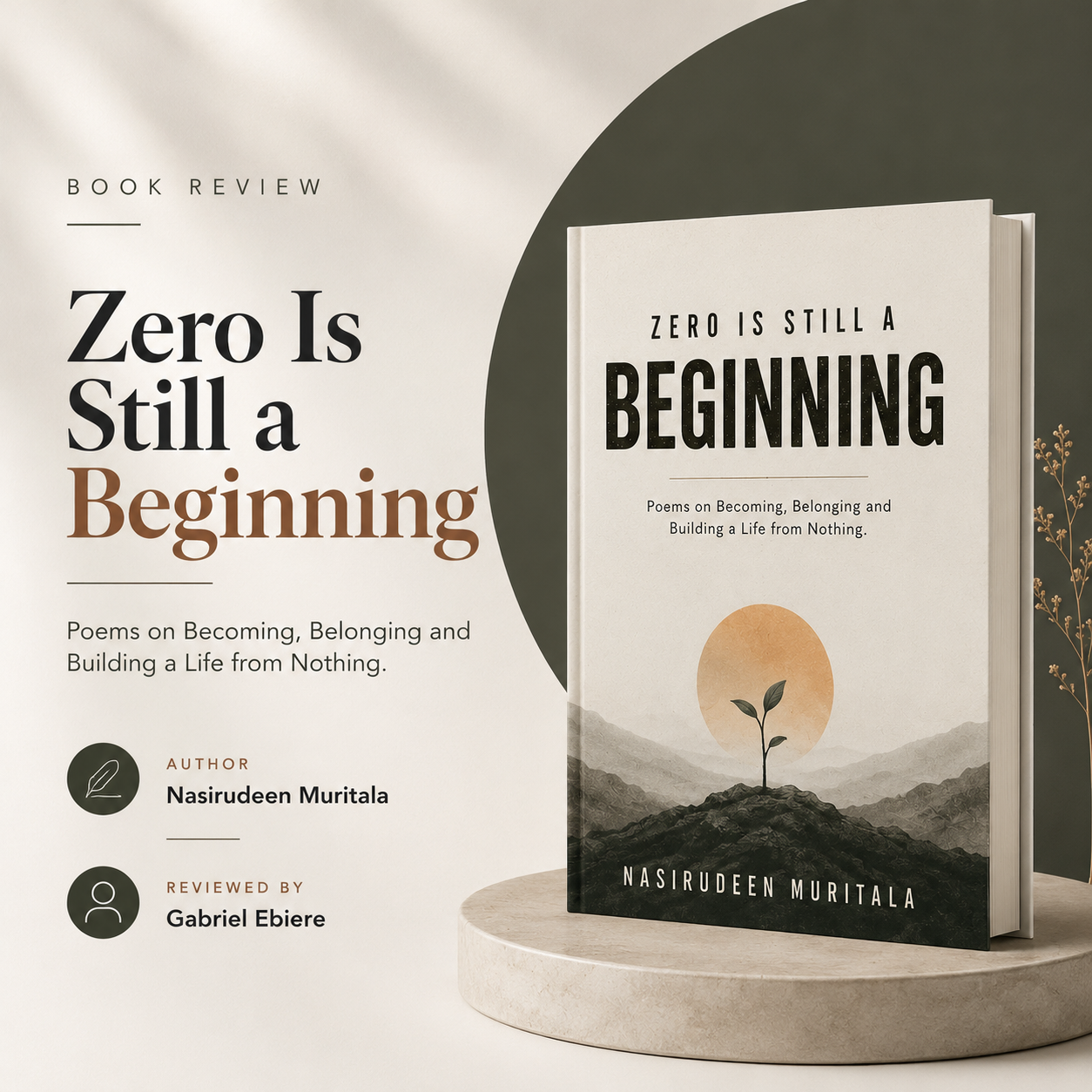
Book: Zero Is Still a Beginning (Poems on Becoming, Belonging and Building a Life from Nothing).
Author: Nasirudeen Muritala
Reviewed by: Gabriel Ebiere
Published: 2026
What does it mean to begin again when life has given you little reason to believe in beginnings? How does one build an identity from the fragments of childhood, unmet expectations, emotional deprivation, and responsibilities assumed too early? These questions lie at the heart of Zero Is Still a Beginning: Poems on Becoming, Belonging and Building a Life from Nothing, a poetry collection by Nasirudeen Muritala that explores the complicated relationship between personal history and the possibility of self-reconstruction.
At its core, the collection is concerned with the human struggle to become whole without denying the experiences that have contributed to one’s brokenness. Through reflections on childhood, growing up, independence, responsibility, and the enduring desire to be understood, Muritala presents a deeply personal meditation on what it means to build a life when the foundations appear inadequate. The collection’s central proposition is both simple and profound: beginning from nothing does not necessarily mean having nothing to become.
The Philosophy of Beginning Again
The title is the collection’s most immediate philosophical statement. Ordinarily, zero signifies absence, emptiness, failure, or the point at which previous efforts appear to have yielded nothing. Yet, in Muritala’s formulation, zero is not merely an endpoint; it is a beginning. This distinction transforms the title from a declaration of disadvantage into an invitation to reconsider how human progress is measured.
The significance of this idea extends beyond conventional narratives of success. Beginning again is not always the dramatic experience of overcoming adversity and emerging victorious. Sometimes, it involves the quieter work of understanding oneself, acknowledging what was lost, and accepting that the future cannot compensate perfectly for the past. The collection’s title, therefore, suggests a more complicated understanding of resilience: the ability to move forward without pretending that the journey has been easy.
By framing personal development as a process rather than a destination, Muritala engages a question that resonates across generations: must a person’s beginning determine the limits of their becoming? His collection invites readers to consider the possibility that a difficult origin need not constitute a permanent definition.
Childhood, Responsibility, and the Unequal Experience of Growing Up
One of the collection’s most compelling thematic concerns is the relationship between childhood and adulthood. Growing up is often presented as a natural progression towards independence, but Muritala’s exploration of early responsibility complicates this assumption. For some people, adulthood begins long before they possess the emotional resources or social freedom necessary to navigate it.
This tension gives the collection much of its emotional significance. When a child is required to assume responsibilities beyond their years, the resulting maturity may be admirable, but it can also conceal needs that remain unmet. Competence becomes visible to others, while vulnerability goes unnoticed. The child learns to function, yet the desire to be cared for does not necessarily disappear.
Such experiences raise difficult questions about family expectations, sacrifice, and the boundaries between discipline and emotional neglect. They also challenge the tendency to celebrate prematurely matured children without considering what their circumstances may have cost them.
Muritala’s treatment of this subject is particularly relevant in societies where economic hardship, family obligations, and unequal access to opportunity frequently require young people to grow up quickly. His thematic concerns invite readers to recognise that responsibility, although sometimes necessary, should not automatically be mistaken for emotional readiness.
More importantly, the collection’s attention to childhood suggests that becoming an adult does not erase the younger self. The past remains present in the expectations one develops, the relationships one forms, and the ways one responds to disappointment. Personal growth, therefore, requires more than acquiring the language and responsibilities of adulthood; it also demands an honest reckoning with the experiences that shaped one’s earliest understanding of the world.
Belonging and the Search for Recognition
Belonging is another important dimension of the collection’s thematic framework. To belong is not simply to occupy a place within a family or community. It is to experience acceptance without having to continually prove one’s worth. For individuals whose formative experiences have involved comparison, exclusion, or insufficient affirmation, the search for belonging can become inseparable from the search for identity.
The collection’s focus on personal development consequently opens into a broader examination of recognition. Who does a person become when the people whose approval matters most cannot provide it? How does one learn to value oneself when validation has been inconsistent or absent?
These questions are significant because the desire for recognition often survives long after the circumstances that produced it have changed. Achievements may provide temporary reassurance, but they cannot always resolve the deeper longing to have one’s experiences acknowledged.
Muritala’s larger thematic movement towards self-understanding offers a useful framework for considering this struggle. Belonging may begin with relationships, but it cannot depend entirely on external approval. A sustainable sense of identity requires the difficult work of recognising one’s own experiences as worthy of attention, even when others have failed to acknowledge them.
Nevertheless, the pursuit of self-acceptance should not be confused with the elimination of the human need for connection. The desire to be understood is not a weakness, and independence does not require emotional isolation. The tension between these realities gives the collection’s central concerns their psychological depth.
The Craft of Making Experience Meaningful
The effectiveness of autobiographical poetry depends partly on the writer’s ability to transform private experiences into language that invites public recognition. Personal history, however painful, does not automatically become compelling literature. It must be shaped through imagery, structure, rhythm, perspective, and a deliberate understanding of what language can communicate beyond its literal meaning.
In this respect, the collection’s reported use of free verse, conversational language, enjambment, and symbolic imagery provides an important framework for examining its literary approach. These techniques can allow difficult experiences to emerge without the constraints of a rigid metrical structure, while preserving the irregular rhythms of memory and reflection.
The reported use of everyday objects as symbols is particularly noteworthy. In the poem “I don’t wait for the bus anymore,” waiting becomes an image of dependence and the frustration of hoping for circumstances to change. Similarly, the key in the poem “Key” signifies more than access to a vehicle—it represents the possibility of directing one’s own life.
These images demonstrate how familiar objects can carry psychological significance. A bus stop can become a site of uncertainty, while a key can embody the difficult transition from dependence to agency. The ordinary acquires meaning because it becomes associated with an emotional or developmental turning point.
Such symbolism is effective when it allows readers to discover meaning rather than merely receive an explanation. It creates room for interpretation, enabling the reader to connect the poet’s experiences with personal memories of waiting, striving, and eventually taking responsibility for the direction of one’s life.
The collection’s accessible language also offers an opportunity to reach readers who may not ordinarily engage with poetry. Yet simplicity is most powerful when it preserves complexity. The challenge for a poet writing in a direct, conversational register is to ensure that familiar language continues to reveal something unfamiliar about the human experience.
Healing Without Erasing the Past
Perhaps the most significant implication of the collection’s central argument is its understanding of healing as a process of integration rather than erasure. There is a temptation to measure recovery by how completely a person can distance themselves from painful experiences. Muritala’s thematic concerns suggest a more nuanced possibility: one can acknowledge the past without surrendering the future to it.
This distinction matters because not every loss can be reversed. Time cannot be recovered simply because one has finally acquired the resources, understanding, or freedom that were previously unavailable. Nevertheless, the inability to change the past does not eliminate the possibility of changing one’s relationship with it.
The adult who revisits childhood must therefore confront two realities simultaneously: the grief of what was missing and the responsibility of deciding what comes next. This is not a simple movement from suffering to triumph. It is a negotiation between memory and possibility—between the person circumstances produced and the person one still hopes to become.
Such an approach avoids the limitations of motivational narratives that treat adversity as a necessary ingredient of success. Pain does not automatically make people stronger, and suffering should not be romanticised merely because someone eventually learns to live beyond it. What matters is the possibility of finding meaning without pretending that the original experience was desirable.
Final Verdict: A Beginning That Refuses to Be an Ending
Zero Is Still a Beginning presents a compelling thematic proposition: the circumstances from which a person emerges need not dictate the possibilities available to them. Through its concerns with childhood, responsibility, identity, belonging, and emotional reconstruction, the collection invites readers to reconsider the relationship between their histories and their futures.
Its greatest potential lies in the intersection between personal vulnerability and shared human experience. Although individual circumstances differ, the desire to be understood, the grief of unmet expectations, and the determination to build a meaningful life are experiences that cross social and generational boundaries.
For readers navigating difficult beginnings, negotiating adulthood, or learning to reconcile their present identities with their younger selves, the collection offers an opportunity for reflection. Its title, in particular, challenges the assumption that a life must begin with abundance, certainty, or favourable circumstances to possess the possibility of growth.
Ultimately, zero is meaningful not because it guarantees success, but because it refuses to make failure, deprivation, or an imperfect beginning the final word. A life can begin again without becoming untouched by its history. A person can move forward without pretending that nothing was lost. And becoming, perhaps, is the patient work of building a future while finally learning how to understand the person who had to survive the past.
Bio of reviewer
Gabriel Ebiere Blessing is a Nigerian writer and spoken-word artist whose work interrogates the complexities of human existence, faith, identity, and the delicate intersections between personal experience and collective realities. Her writing is characterised by emotional depth, contemplative inquiry, and a keen sensitivity to the unspoken narratives that shape human lives. Her work reflects a sustained interest in the transformative possibilities of words and their capacity to deepen human understanding.
0 yorumlar