
 Divinefavour Ndada
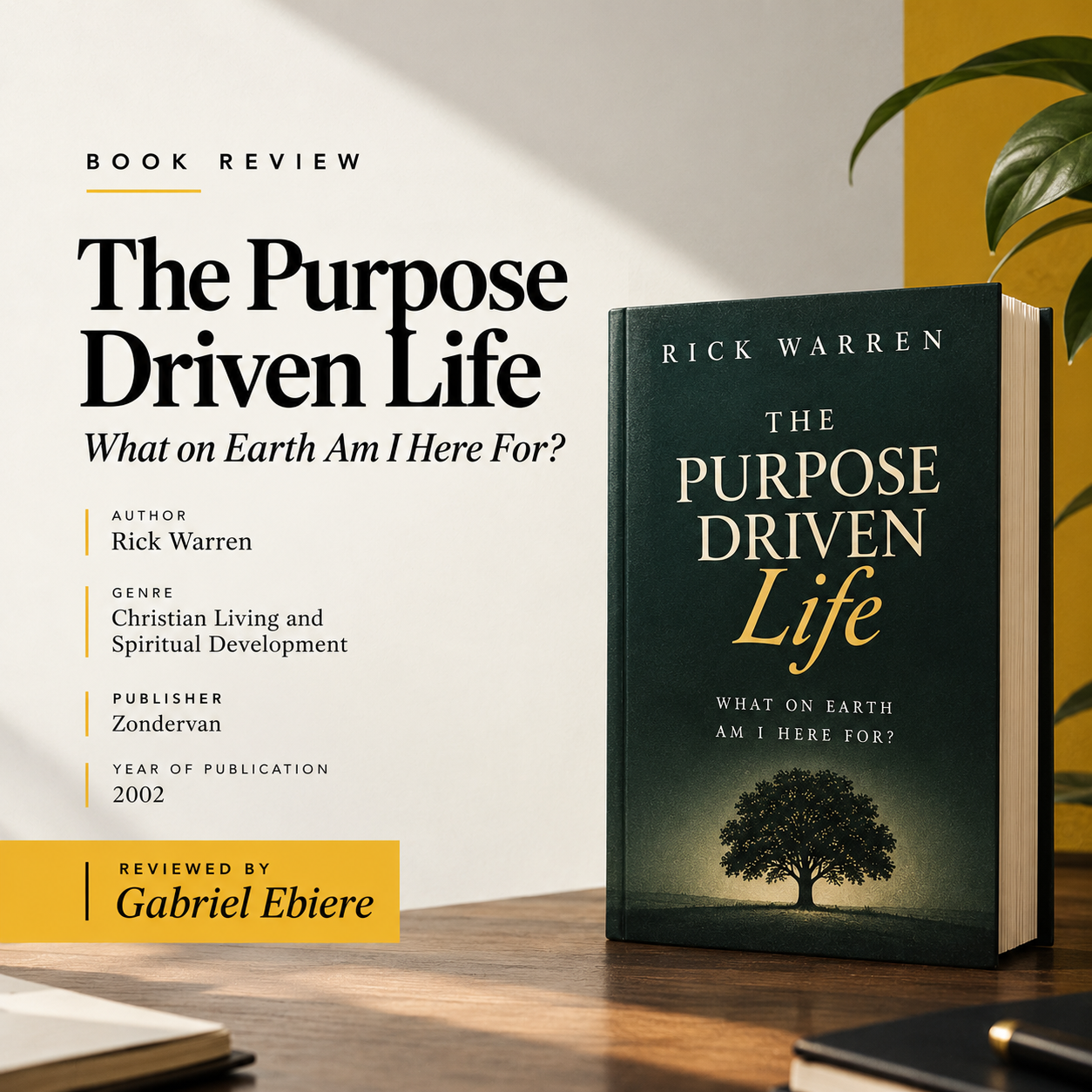
Title: The Purpose Driven Life: What on Earth Am I Here For?
Genre: Christian Living and Spiritual Development
Publisher: Zondervan
Year of Publication: 2002
Reviewed by: Gabriel Ebiere
Introduction
The Purpose Driven Life by Rick Warren is a Christian inspirational book that explores one of humanity’s most important questions: What on earth am I here for? First published in 2002, the book presents a biblical perspective on the meaning of life, emphasising that human existence is not accidental but rooted in God’s divine purpose. Rather than encouraging readers to build their lives around personal ambitions, material possessions, or societal expectations, Warren argues that true fulfilment comes from understanding and living according to God’s intentions for humanity. Structured as a forty-day spiritual journey, the book encourages readers to reflect on their relationship with God, their responsibilities to others, and their contribution to the world. Its central message is that discovering purpose begins with God, the Creator, rather than with the individual.
Summary of the Book
Warren organises his central argument around five purposes he believes God has established for human life: worship, fellowship, discipleship, ministry, and mission. These purposes provide a framework for understanding how Christians can live meaningful, balanced, and spiritually fruitful lives.
The first purpose is that we were planned for God’s pleasure. Warren explains that humanity was created to know, love, and worship God. Worship, therefore, extends beyond singing in church or participating in religious activities. It involves living in a manner that honours God through our attitudes, choices, obedience, and everyday relationships.
The second purpose is that we were formed for God’s family. This section emphasises the importance of Christian fellowship and belonging to a community of believers. Warren presents relationships as essential to spiritual growth, encouraging Christians to practise love, forgiveness, unity, and mutual support. Faith, in this sense, is not intended to be lived in isolation.
The third purpose is that we were created to become like Christ. Warren describes spiritual maturity as an ongoing process through which believers develop Christlike character. This involves learning humility, patience, integrity, love, and obedience to God. The goal is not simply to acquire biblical knowledge but to allow God’s Word to transform one’s character and conduct.
The fourth purpose is that we were shaped for serving God. Warren teaches that every individual has gifts, abilities, experiences, and opportunities that can be used to serve others. Christian service is not restricted to pastors or church leaders; every believer has a role to play in meeting human needs and contributing to God’s work.
Finally, we were made for a mission. Warren encourages Christians to share their faith and participate in God’s work of reaching others. He presents evangelism as a responsibility that extends beyond the pulpit into everyday interactions, relationships, and acts of service. Together, these five purposes form the foundation of his argument that a meaningful life is one centred on God and expressed through love, growth, service, and mission.
Critical Evaluation
One of the book’s greatest strengths is its clarity and accessibility. Warren discusses profound spiritual questions in straightforward language, making the book suitable for new believers, mature Christians, church groups, and individuals seeking direction. Its forty-day structure also encourages consistency by breaking the journey into manageable daily readings.
Another strength is the practical approach of the writing, as the average person can relate to the daily practical exercises given at the end of every chapter. Warren does not treat faith as a collection of beliefs detached from everyday life. Instead, he connects spiritual growth to personal character, relationships, service, and responsibility. This approach challenges readers to examine whether their daily choices reflect their professed beliefs.
Furthermore, the book challenges the tendency to measure success through wealth, status, recognition, or personal achievement. It reminds readers that a person’s value cannot be determined solely by external accomplishments. From Warren’s perspective, success must ultimately be understood in relation to God’s purpose.
However, the book also has limitations. Its strong emphasis on God’s general purposes for humanity may leave some readers wanting more detailed guidance on identifying their particular calling, gifts, or direction in specific circumstances. Although the five purposes provide a valuable foundation, applying them to complex decisions involving careers, relationships, finances, and ministry may require additional prayer, biblical study, wise counsel, and personal reflection.
Additionally, readers may find that some of its explanations require further examination within their own church traditions and theological understanding. Nevertheless, these limitations do not diminish the book’s central contribution to Christian spiritual formation.
Lessons and Personal Reflections
The most significant lesson from The Purpose Driven Life is that purpose must be understood in relation to God rather than personal ambition alone. The book encourages readers to move beyond asking what they want to achieve and begin considering how their lives can honour God and benefit others. It also demonstrates that purpose is not necessarily revealed through one dramatic experience. It can become clearer through daily obedience, spiritual growth, faithful service, and meaningful relationships. A person’s ordinary responsibilities can become expressions of divine purpose when approached with the right attitude and commitment. Ultimately, the book challenges Christians to evaluate their priorities and ensure that their pursuit of success does not overshadow their relationship with God, their character, or their responsibility to others.
Conclusion
In conclusion, The Purpose Driven Life by Rick Warren is a valuable contribution to Christian literature because it offers a practical biblical framework for understanding human existence. Through its five central purposes, the book encourages readers to worship God, build meaningful Christian relationships, develop Christlike character, serve others, and participate in God’s mission. Its greatest contribution is its reminder that life is more meaningful when it is lived beyond self-interest and aligned with God’s purposes. Although discovering how these principles apply to individual circumstances requires continued reflection and spiritual growth, Warren provides a useful starting point for anyone seeking to live intentionally. I would recommend this book to Christians who desire a deeper understanding of their faith, a clearer sense of life’s priorities, and a more purposeful approach to everyday living.
Gabriel Ebiere Blessing is a Nigerian writer and spoken-word artist whose work interrogates the complexities of human existence, faith, identity, and the delicate intersections between personal experience and collective realities. Her writing is characterised by emotional depth, contemplative inquiry, and a keen sensitivity to the unspoken narratives that shape human lives. Her work reflects a sustained interest in the transformative possibilities of words and their capacity to deepen human understanding.
0 הערות