
 Divinefavour Ndada
The themes of motherhood or femininity have gained considerable representation and valorisation among emerging poets and writers in recent years. Fatherhood or masculinity, on the other hand, has been relegated to the fringes of textual representations. The dominant, all-knowing patriarchal male figure is no longer the bravest and wisest literary character, nor is he the centre of influence as he was several decades ago, when masculinity was viewed and projected as the pillar of traditional African societies. That assumption has been demystified through the sturdy representations of matriarchal agency in contemporary literature. Whether in poetry or fiction, matriarchal narratives have emerged as a critical force shaping new perspectives on female agency. These representations are not accidental; they are a deliberate institutionalisation of women’s social realities, forged against the background of the perceived misrepresentations in early written African literature.
Perhaps what makes these representations even more interesting is that several male writers, like Abubakar Adam Ibrahim and Obinna Udenwe, have devoted a large chunk of their literary works to celebrating and projecting the realities of women. Add this to a list of hundreds of renowned female authors, and you have over two decades of a new generation of readers feasting on various versions of feminist ideologies. This reality cannot be uprooted from the acute interest in celebrating motherhood and amplifying the agency of women in literary texts by younger writers.
This assertion does not invalidate the earlier pioneering male textualisation of women, not as subordinates but as strong social and spiritual forces in African literature. Whether it is Christopher Okigbo’s famous deference to “Mother Idoto”, before whom he stands naked in “The Passage”, a symbolic representation of the spiritual and cultural essence of motherhood, or the works of Sembène Ousmane in God’s Bits of Wood, Nuruddin Farah in From a Crooked Rib, Ngũgĩ waThiong’o in Petals of Blood, and others, African literature by male authors has never been devoid of strong matriarchal voices that validate the contributions of women to the development of African societies or the significance of their cultural and spiritual essence.
The crux of this argument is not the denial or exclusion of patriarchal representations or masculinity in contemporary literature by younger writers. It is also not an argument over patriarchy versus matriarchy; it is an attempt to juxtapose how the perceived dominant narratives in favour of masculinity may have shifted in recent literary representations towards the centralisation of matriarchal influences among the younger generation of writers. Recently, I read a poetry collection by Isaac Miebi Mendez titled Sessions of Sandstorms, in which he deconstructs fatherhood, highlighting how a father’s personal failings and generational curses could become the bane of the trauma suffered by a generation of innocent children. Mendez’s harsh representation of fatherhood is not an isolated case. There is an avalanche of contemporary literary texts in which fatherhood or masculinity is deconstructed and projected in the context of abuse and personal failures.
Amidst this perception, Gideon Adeyeye provides an alternative response that reimagines fatherhood from a nuanced and constructive perspective, highlighting the sacrificial responsibilities that come with fatherhood. For Adeyeye, fatherhood is not a symbol of failure but a source of inspiration and pride. Both dualities can coexist and are not mutually exclusive. One child can grow up in a home saturated with fatherly love, sacrifice and protection, while another may grow up in a home filled with abuse and trauma. In Adeyeye’s case, the persona grew up in a world in which his father endured humiliating economic conditions, which strengthened his resolve to appreciate his family background and the weight of a father’s inability to provide economic security and protection for his family. Adeyeye does not view a father’s economic circumstances as a direct consequence of personal failure but as an orchestration of nature. Despite the persona’s father’s good intentions and hard work, he is unable to meet his family’s needs, thereby facing humiliation from the landlord and the world around them.
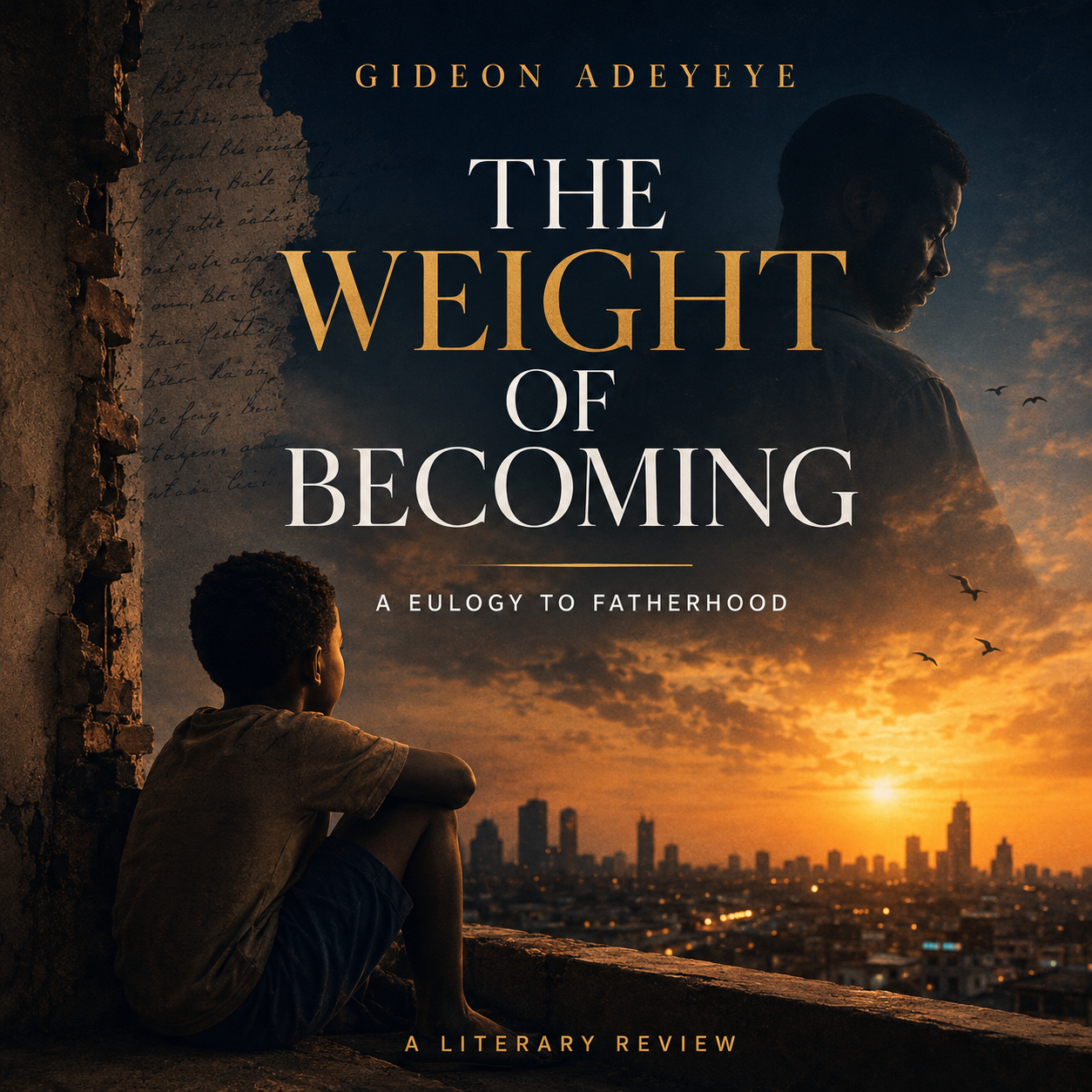
This assertion foregrounds the representation of fatherhood in Gideon Adeyeye’s debut poetry collection, The Weight of Becoming, published in 2026. The 69-page collection contains 19 narrative poems. Central to the collection’s thematic focus is the overarching influence of fatherhood on the child. Sigmund Freud’s psychoanalytic theory presupposes that an individual’s behaviour in adulthood is shaped by childhood influences. In Adeyeye’s collection, the persona’s perception of life is shaped by the hard lessons he picks up from watching and listening to his father as he grows into adulthood.
Thus, the collection eulogises fatherhood; it celebrates the essence of fatherhood as an embodiment of sacrifice and love. But the greater consequence of Adeyeye’s representation lies in the many lessons the collection contains for boys. For example, the message in the title of the collection lies in the deeper meaning that every boy or child carries the weight of becoming a man, of becoming the provider and redeemer of his family from socioeconomic woes, as the persona demonstrates in the collection.
There is a truism that becoming a man is not a day’s job. It takes years of pain and sacrifice to become a man, even when it entails losing yourself. Often, the weight of becoming a functional human being is underrated, but a man often has to overcome personal failures, societal challenges and generational curses to forge new legacies rooted in the historical suffering and pain of one’s heritage. This is the core of Adeyeye’s poetic thesis. The Weight of Becoming embodies every father’s wish: may my son be better than me.
To buttress the position of this intervention, a few pieces of textual evidence would suffice. In the opening poem, “First Child”, the persona illustrates the first lesson taught to him by his father: the protection of the family and those who are incapable of defending themselves. The persona reflects on the moment when his brother lay helpless and bleeding, probably after being beaten by other children. Expecting his father to help, he instead watched as his father did nothing and asked him what he was going to do about it. He got the message that he had to protect and avenge his brother. That was when he realised that being a “First Born” came with the unique responsibility of being a protector. The persona’s reflections are presented below:
So I stood.
For my brother.
I found my voice.
I took back his power from the hands that tried to steal it.
And that day, I stopped being just a brother.
I became a protector.
The Weight of Becoming by Gideon Adeyeye
When I came back, my father didn’t clap.
He didn’t make a speech.
He just smiled and said,
“You’ve done a good job.” (pp. 6–7)
The above stanzas convey an important lesson about being a protector and looking out for others. This is one of the foundational lessons of fatherhood: inculcating egalitarian values in children who grow up to become functional members of society. The persona reiterates this assertion in the stanza below:
Because being firstborn isn’t a privilege.
It’s a calling.
To carry the weight before anyone feels it.
To walk first so others learn the path.
To be strong until they are strong enough to stand alone.
Who look out for the interest of others. (p. 8)
In the poem “Two Naira”, the persona recognises the sacrifice his parents made and how his father ensured they went to school even though they had little money. Seeing his father struggling and enduring humiliation from the landlady’s son, the boy resolves to change the trajectory of his family’s life, not by hating his father or blaming him for their poverty, but by determining to work hard and do better. This sentiment is captured in the stanza below:
Today,
the boy who watched his father bleed
now places house keys and car keys
into those same hands that once carried the burden.
The parents who once counted two naira
now count blessings.
And every memory has turned to testimony. (pp. 10–11)
It is every father’s wish that his child should become a better version of himself. That is what the persona demonstrates in this poem by changing the family’s economic plight through hard work and dedication to the things that matter. In a healthy home, a child sees the sacrifices of their parents and makes a silent commitment to do better to help liberate the family from poverty. But only a self-assured child has the ability to look beyond his father’s failings and look inwards at what he could do better by correcting the years of economic displacement. Every parent would be proud of a hardworking child who understands the weight and essence of family.
Perhaps the most profound representation of fatherhood and a father’s sacrifices is articulated in the poem “The Man Who Came Home Tired”, in which the persona portrays the image of a father who comes home after a hard day’s work, tired and weak. But there is a contrast in the representation when the persona states that he used to think that “Men came home tired/Because they worked”, but he realises, by observing his father, that men come home tired not because of work but because they have spent the whole day pretending not to be afraid. The stanza is reproduced below for emphasis:
I know better now.
Some men come home tired
because they have spent the whole day
pretending not to be afraid. (p. 31)
The stanza holds a truth to which not many pay attention: fathers, too, are burdened by the weight of failure and the inability to provide for their families. This is one of the greatest burdens that society often fails to recognise because a man is supposed to be tough and strong. A man is not supposed to fail or show emotions, so he carries a heavy burden and pain that can undermine his mental health. The persona goes on to list some of the things that contribute to the burden men carry in silence:
Afraid of school fees.
Afraid of rent.
Afraid of the cough
that has stayed too long.
Afraid of a child asking for something
you cannot afford. (p. 31)
The poem provides a contemplative reflection on societal expectations of men while drawing attention to the pain they endure in silence and the fear they hide from the eyes of the world. Perhaps, if the world looked more closely at the conditions of men, it would see the unspoken truth about the pain they carry inside. The persona’s compassion for his father comes through when he observes:
I understand him now.
There are battles
children should not have to see.
So fathers hide them
behind a smile,
a joke,
a plate of food,
a hand on the shoulder. (p. 33)
Often, society pretends not to be aware of what fathers go through; it prefers gloating over a father’s failures to acknowledging his sacrifices and pain. This is why Adeyeye’s work is unique. It humanises fatherhood and casts light on the plight of fathers, not by blaming anyone but by illustrating the weight that men carry, even when they fail to become part of the statistics of successful fathers.
Adeyeye’s unique representation of fatherhood offers an alternative perspective on how society perceives the role of fathers. It is only the success and comfort they provide that the world celebrates, not the pain and sacrifices they endure. This is an instructive tribute to fatherhood, a refreshing examination of the relationship between societal expectations and the actual burden that fatherhood entails. This message runs throughout the collection.
In conclusion, Adeyeye’s work is an important contribution to the emerging poetics of fatherhood and deserves critical attention. However, the collection is not without its flaws. Most importantly, it falls short in artistic depth; its message is more nuanced than the artistry that conveys it. For a work of poetry, it could have been more carefully crafted and better edited. For example, in the opening poem and elsewhere, there is evidence of poor editing, such as the indiscriminate use of full stops at the end of every line, as seen in the stanzas cited in this review. With better craft and editing, the collection could easily become a poetic gem. Regardless of these shortcomings, this is a fine collection that deserves attention.
Paul Liam is a poet, author and culture writer based in Abuja.
0 মন্তব্য