
 Divinefavour Ndada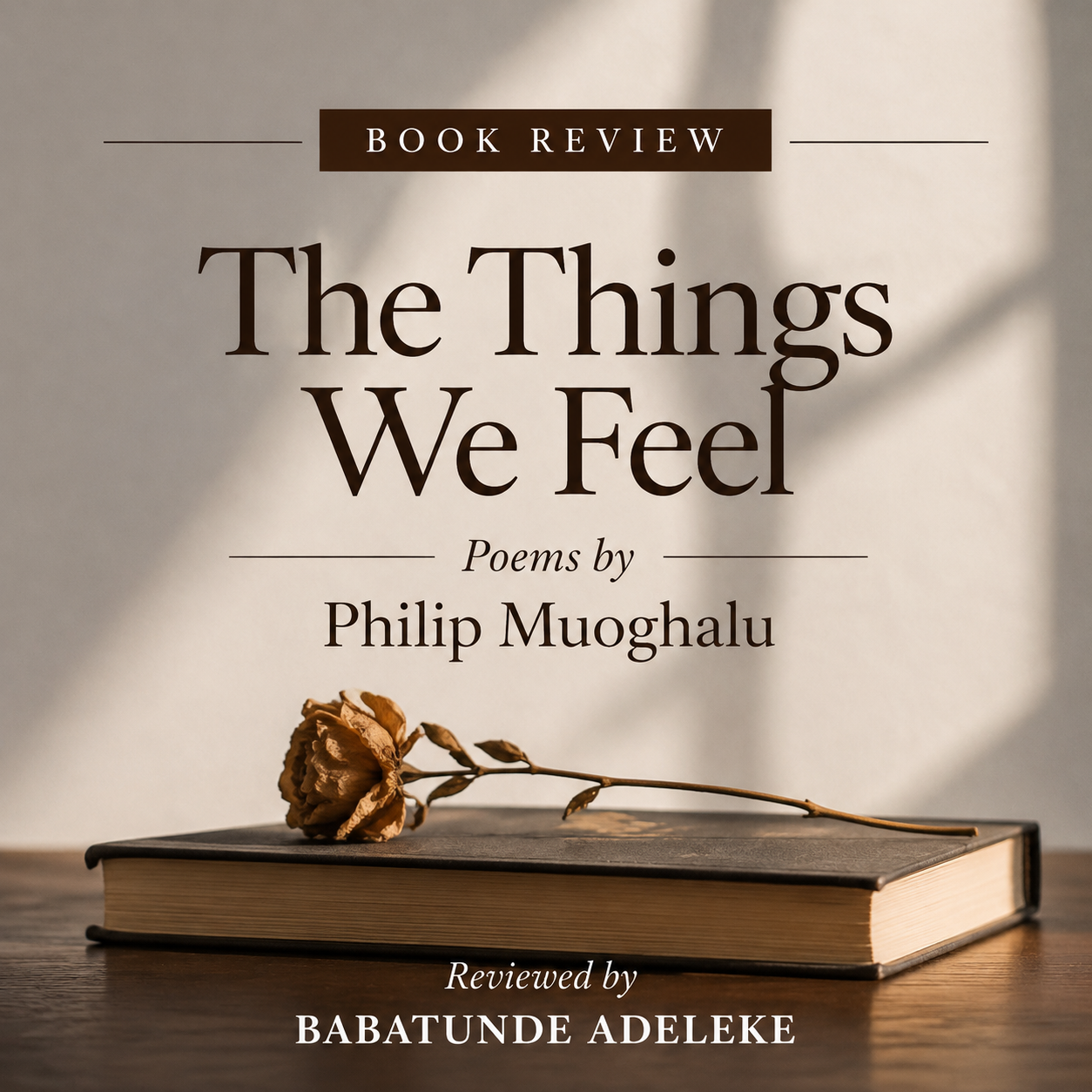
Feeling Everything, Naming Nothing New
Philip Muoghalu’s debut maps the ordinary emotions of a life stretched between Nigeria and Britain.
The title of Philip Muoghalu’s first collection, The Things We Feel, is almost defiantly plain. Fifteen sections follow: Death, Love, Anger, Fear, Sadness, Joy, Cold, Food, Marriage, Politics, Relocation, Friendship, Mother, Banking, Family. It looks, at first glance, like a catalogue. What you get instead is something narrower and more useful: the interior weather of a Nigerian man who has moved continents, become a father, and is still trying to work out which parts of his life he chose and which parts simply happened to him.
Muoghalu spent years in Nigerian banking before coming to the UK for graduate school. You can feel that history in the poems even when he does not spell it out. The cold lands differently. Marriage arrives as a social pressure before it arrives as a desire. Fatherhood rearranges the furniture. And underneath all of it sits the fact of a father who died when the poet was three months old, a loss that has no memories attached to it, only the long afterlife of absence.
That absence produces the best writing in the book. In the opening sequence on Death, Muoghalu writes:
You became a story before a memory,
a photograph before a presence.
It is a simple distinction, and it is devastating. Most people who lose a parent at least have something to remember badly. Muoghalu has the opposite problem. He has material (photographs, other people’s stories, the silence that follows a name) but no first-hand residue. Later he pushes the idea further:
This is death’s cruelest mathematics:
you became the missing number
in an equation I was too young to understand.
The metaphor works because it refuses drama. A missing number is not a tragedy in the operatic sense. It is just a problem that cannot be solved in the ordinary way. The same clarity shows up in the couplet that may be the strongest in the collection:
While others mourn what they remember,
I mourn what I was never given.
A lot of elegies pretend that memory is the wound. This one admits that the wound is the lack of memory itself. That is a harder thing to write, and Muoghalu gets it right.
The poems about arriving in Britain have a similar exactness. In Cold, the speaker walks out of the airport in African fabric, still carrying the confidence of someone who thinks he has prepared. Then the wind hits. He turns around and runs back inside. The line that stays with you is almost blunt:
You can prepare your clothes
and still be unprepared for the cold.
It is funny in a small way, and it is not only about weather. The same double feeling runs through the Relocation poems. People back home treat the move as pure success. The person who moved knows it is also a kind of loss. Muoghalu puts it without decoration:
I can be thankful for where I am
and still grieve where I came from.
No resolution is offered. The two feelings are allowed to sit there together. That is rarer than it should be.
When his son is born, Muoghalu writes that the child “introduced me to myself.” It is a neat reversal: the father does not introduce the world to the infant so much as the infant hands the father back a version of himself that grief and work had partly buried. The poem does not claim that joy cancels pain. It only says that joy gives the pain something else to look at. That feels true, and it feels lived.
The Mother section works in a similar register. Muoghalu has watched his mother go without and still ask whether he has eaten. He lands on a definition that is plainer than most:
Motherhood is not only
the ability to bring life into the world.
It is the willingness
to keep giving life to someone
after they have arrived.
The point is ordinary and hard to argue with. What makes it land is the detail around it: empty purses, meals pushed across the table, tired eyes that still have to become strength. When Muoghalu stays close to what he has seen, the poems hold.
Even the Love section, which could easily have slipped into cliché, has a few lines that feel observed rather than borrowed. Love, he writes, “rarely knocks. / It slips through the window / while you are busy calling it friendship.” Later it “rearranges the furniture of your heart, / hangs somebody’s name on the walls, / and leaves you wondering / who gave it permission to redecorate.” The domestic metaphor is slight, but it is more interesting than the usual storm-and-wound vocabulary. Love as unauthorized interior design is a small improvement on the tradition.
The trouble is that the book keeps wanting to teach. Too many poems begin in a real situation and end in a moral. Anger should not be invited. Sadness is reminded that morning always returns. Fear is told it may sit beside you but does not get to drive. You can feel Muoghalu’s good intentions, and you can also feel the poems closing down too early. They decide what the feeling means before the reader has had time to sit with the feeling itself. The stronger passages are the ones that refuse to tidy up.
Something similar happens with the social material. On marriage, Muoghalu is clear and culturally specific:
Singleness is not a waiting room
where life sits until marriage arrives.
That is a good line. It names the assumption underneath a lot of family pressure. But the surrounding argument sometimes crowds the poetry out. The Politics poems have the same problem: the critique is intelligible, the images are thinner, and the language starts to sound like an essay that has been broken into lines. You can see a writer who has thought hard about institutions and has not yet fully figured out how to make that thinking behave like a poem.
Formally, the book is unpretentious. Free verse, conversational line breaks, almost no interest in sound pattern or structural risk. When the poems work, they work because the experience is specific, not because the technique is doing heavy lifting. That is a legitimate choice. Plenty of good poetry has been written in this register. The downside is obvious: when the thought goes soft, there is nothing else to carry the page.
The voice itself stays steady: earnest, reflective, rarely ironic. Muoghalu does not undercut his own sincerity, and he does not perform cleverness for the reader’s approval. In the current climate that can feel either refreshing or exposed. Readers who want linguistic fireworks or tonal complexity will be disappointed. Readers who want someone to name ordinary difficulty without flinching may find the book more companionable than many flashier collections.
In the end, The Things We Feel is a record of a life being examined while it is still in motion. The best pages stay close to the particular: the father who became a photograph before he could become a presence, the first British winter that no amount of clothing could fully prepare for, the son who hands a man back to himself, the mother whose giving never quite gets announced. When the poems trust those details, they earn their keep. When they reach for the general lesson, they sound like the kind of poetry that comforts more easily than it unsettles.
Both tendencies are present, and both make sense in a debut. The more interesting one is the tendency that does not yet know how the sentence should end. If Muoghalu keeps trusting the specific wound and the specific weather, the work will get harder and better. As it stands, the book is honest more often than it is fully realized. That is not nothing. It is a start.
Babatunde Adeleke is a Nigerian writer, poet and communications professional. His work has appeared in Nigerian Tribune, Sahara Reporters, Inside Kaduna and LagosToday, among others. He is the author of Origami and Pleasure Field, both poetry collections. He writes book reviews for several outlets.
0 kommentarer