
 Divinefavour Ndada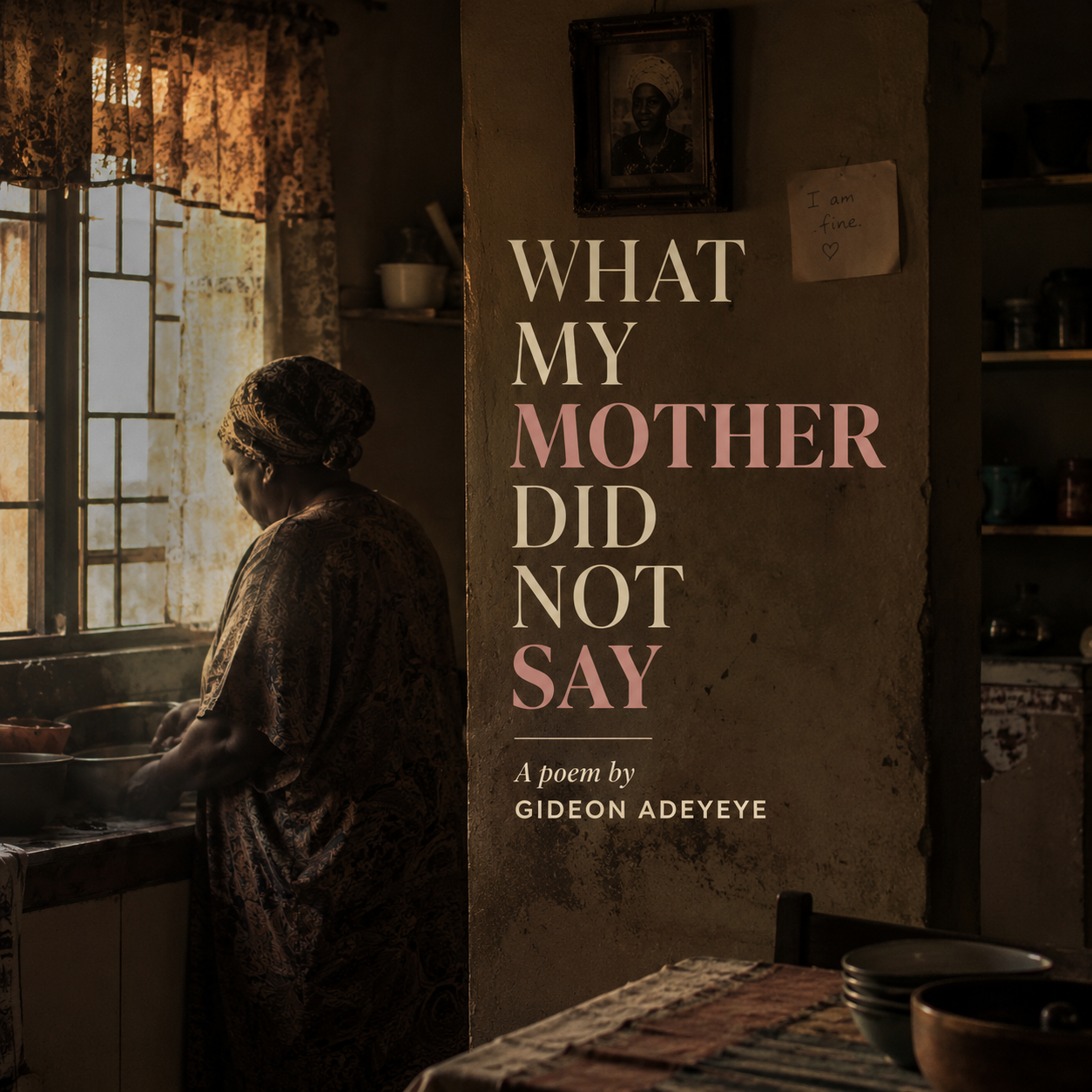
My mother never said
she was tired.
She simply became quieter.
That was how I knew.
The plates were washed
a little slower.
The evening conversations
became shorter.
As a child,
I thought mothers
were made differently.
Like walls.
Always standing.
Always available.
Always knowing where everything was.
Who had eaten.
Who was sick.
Who had homework.
Where the missing socks were.
Which child was pretending
not to be hungry.
I did not know
a mother could be tired
of being needed.
I know now.
I remember her hands most.
Those hands
that could knead dough,
wash clothes,
braid hair,
wipe tears,
cook for ten,
and still find the strength
to touch my forehead
before bed.
Hands that knew
how to comfort everyone
except themselves.
Sometimes I wonder
who comforted my mother.
Who told her
she had done enough?
Who asked
whether she was afraid?
I wish I had known.
I would have sat beside her.
I would have taken the bowl
from her hands.
I would have said,
“Mum,
leave it.
The dishes can wait.”
But children are selfish
without knowing they are.
We think mothers
are permanent.
We think fathers
are permanent.
We think home
is a place that waits for us
exactly as we left it.
Then one day
the chair is empty.
The voice is softer.
The hands move slower.
And suddenly
all the ordinary things
we ignored
become sacred.
Now when my mother calls,
I do not rush her.
I listen.
Even when she repeats herself.
Especially then.
Because one day
there may be no story
to repeat.
No voice
to complain.
No hand
to reach through the phone.
And I will give anything
for one more ordinary conversation.
So this is for mothers:
For the meals nobody thanked you for.
For the clothes you washed
while your own heart
needed tending.
For the dreams
you postponed
so someone else could breathe.
For every “I am fine”
you swallowed
because the family needed
you to be.
We noticed.
Maybe not then.
Maybe not enough.
But we notice now.
And if love
could travel backward,
I would send it
to every tired version
of my mother
and tell her:
You were never invisible.
We were just too young
to understand
how much of yourself
you gave away
to make us whole.
About the poet
Gideon Adeyeye is a Nigerian-born poet and spoken word artist based in Manchester, UK. His love affair with poetry began in 2018 during his final year at university at Dwelling Place, a programme organised by FCS. Watching poets perform with such depth awakened a fascination with the power of spoken words. With vivid storytelling, Gideon turns lived experience into poetry that feels both personal and universal. His work often journeys from pain to purpose, from hardship to hope, asking what we become when life demands strength before we are ready.
For Gideon, poetry is more than words on a page, it is testimony. A way of looking back at where we have been, honouring those who carried us, and declaring that our beginnings do not have the final word.
0 kommentarer