
 Divinefavour Ndada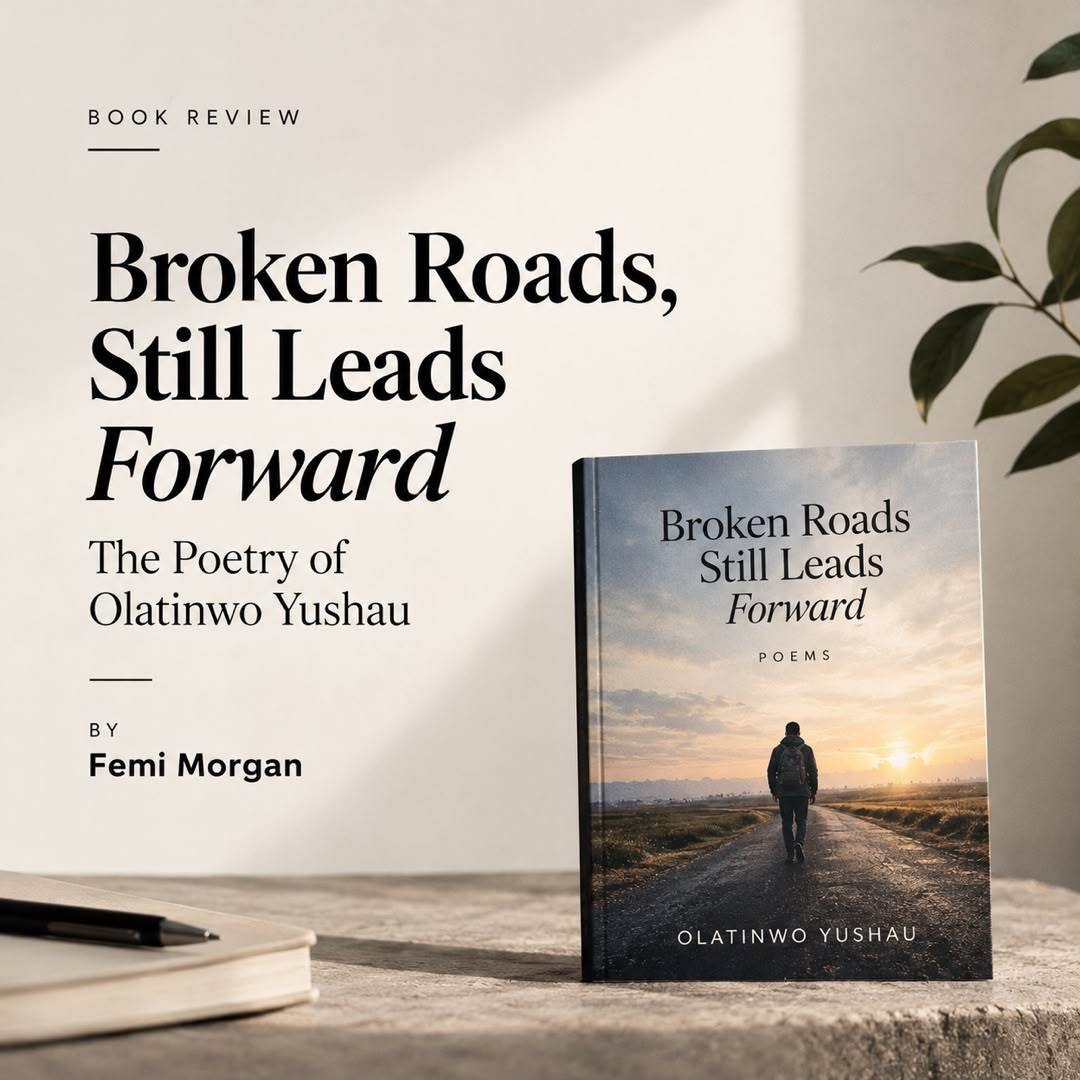
Broken Roads, Burning Hearts: The Poetry of Olatinwo Yushau
By Femi Morgan
There is a certain kind of courage that lives in the ordinary. It does not announce itself with trumpets or seek the spotlight. It simply endures through cold mornings, through long hours, through the quiet indignities that life sometimes demands.
Olatinwo Yushau's debut poetry collection, Broken Roads Still Leads Forward, is a testament to this quiet courage. It is a work that holds promise, tackling both universal and existential themes with language that is simple yet accessible. The performance poet, whose work has appeared in Tribune Daily Newspaper, UpwriteMagazine, and Poetreel.com, has clearly invested time in working and reflecting on life. Yet, for all its strengths, the collection also reveals areas where the poet might grow, particularly in the use of literary devices, nuance, and formalism.
The collection opens its heart with Cold Hands, Burning Hope, a poetic narrative of a car washman enduring the bitter cold. His hands, frosted and numb, tell a story of physical hardship, but his heart, burning with hope, reveals something deeper. The poem's mood suggests that this is not a life he is accustomed to, that he does not hail from places where winter is a threat. There is a tenderness here, a vulnerability that makes his struggle palpable.
Yet, beyond the hardship, there is a subtle celebration of the dignity of work. The poet-persona reminds us that while dreams are valid, the path to greatness must be walked with integrity and honour. Despite the cold, despite the ache, he remains positive, believing that every good thing will eventually come.
My hands became small pieces of winter,
numb beneath the water, aching beneath my sleeves,
but the rent did not care about the cold,
and hunger has never understood
the language of excuses.
I had given my strength to the day,
yet the day gave nothing back,
only another reason to keep fighting.
I promised myself I would find steadier ground,
a proper door, a better future,
and hands that would no longer tremble for survival.
Another poem, Twelve Hours of Tomorrow shifts the gaze to the migrant experience, the harrowing journey of those trying to plant their feet firmly on foreign soil. One of the cruellestchallenges of migration is the erasure of credentials, the nullification of leverage built at home. In the diaspora, the dreams that once seemed within reach are often salvaged only by returning to school, by seeking belonging in the white-collar world.
Unfortunately, it is a drudge, a slow grind, when a white-collar worker, whether from Nigeria or anywhere else, is reduced to blue-collar labour, made to face the harshest weather, weakened by the burden of using hands and bones instead of mind. The new strategy for survival becomes the embrace of long-suffering. The wage is far between, and overwhelming hopelessness is only mildly pierced by hope.
The migrant faces a deep depression, a haggling between mourning and self-motivation. Yet, fortunately, the dream reflects on a good ending.
There were hours when time seemed cruel,
the clock moving like it had forgotten mercy.
I stood where I had to stand,
worked where I had to work,
because education was waiting on the other side.
In The Hands That Raised Me a tribute to motherhood is crafted for a woman who struggled to keep her children alive in the face of gnawing poverty. The poem captures a precocious child's memory of watching his mother count money as though every note had a heartbeat, dividing what little she had into pieces large enough for all of them. The child never forgets such struggle, yet is unable to help the exhaustion wreaking havoc on the mind of the adult parent.
At the heart of this poem is a tribute to the endless long-suffering of a woman willing to sacrifice everything for her children.
I watched my mother count money
as though every note had a heartbeat.
Bills gathered around her like hungry birds,
and she kept dividing what little she had
into pieces large enough for all of us.
A Result That Wasn't Me explores how sickness can affect one's competence and capabilities, leading to failure. Narrating an autobiographical ordeal, the poet creates a nostalgia that resonates beyond the personal. This narrative hints at something larger,that well-being, good health, and humanness have begun to lose their grip on the home soil. How else would a student be allowed to write exams whilst battling a grave illness? Only in a place where poverty, strife, and lack of empathy have eroded the humanity in them.
One month before the examinations,
my body became a country I could no longer navigate.
Illness dimmed the pages before me,
turned concentration into a disappearing door,
and made preparation feel like climbing through smoke.
Another poem, Unread showcases the poet's gift for exploring some of the most complex modern themes with simple language. In this poem, the poet-persona delves into workplace manipulation, how unanswered requests, exclusion, and other silent but effective sabotage can lead to the loss of self-esteem and self-worth. A worker can become a diminishing asset because his emotions, health, and physical abilities are subject to the unity of trauma or connection.
Meanwhile, A Room That Taught Me Kindness explores how shame, kindness, loneliness, dependence, and humiliation can be used as levers of control on someone lacking a place to lay his or her head.
Six Hearts in a Broken Car reflects on the fragility of life, how easily it can be snatched on the asphalt of assumed certainty.
Suitably, What I Lost in Ethereum resonates with the times, considering how money shapes our moods. With the emergence of cryptocurrencies as a rebellious outpost from the strictures of central banks, many young people ventured into it, only to meet their financial Waterloo.
It dawns on the poet-persona that failure bears a "strange silence" as against the celebrations of wealth and victory. Money is no doubt used to negotiate choices between a "sinking feeling" and how one must recover instead of remaining bogged down by the loss.
The poem reminds one of the adventure of Daniel Defoe’s famous novel, Robinson Crusoe. There is no doubt the risk of loss, the uncertainty of recovery, and the urgency of reflection and recalibration. The poet did well to bring to bear that we all journey in search of our personal islands even in modern times.
Money can be rebuilt,
lessons can become armour,
and even ashes can teach the hands how to begin again.
Keeping faith with the motif of loss, The First Time My Heart Broke dwells on the universal theme of how love, unrequited love or heartbreak, and our experience of it shapes our perception. Love often struggles with experience because the heart and the mind argue when love tries to elicit the unity of two distinct selves.
In the case of this poet-persona, his first heartbreak etched a memory within the years where innocence was sabotaged, forming a barricade around one's knowledge of the ways of the world. Having held his hand to the fire sensitively, the poet-persona now learns to limit expectations and develop a thick skin that lacks faith, yet tries to love.
I mistook distance for healing
and silence for strength,
because pain had made me suspicious of tenderness.
Returning to the migrant dilemma, A Seat I Couldn't Take speaks to one of the pains that diasporas bear, the exclusion from tactile and impressionable markers in the lives of their siblings and family members. While there may be positions that suggest that the nostalgia could be cushioned by technology, it remains unresolved and unassuaged in the heart of the migrant.
Although the personal poem consoles the migrant, the reader quickly realizes that if given a choice, he would choose being physically present than merely bearing witness, or sending remittances to the growth of family members.
I imagined the room,
the applause, the photographs,
the people gathered around her achievement,
and wondered how strange it feels
to love someone from across a border.
Some of these poems are autobiographical in nature.
In the poem, The Decision Made in Shock impresses in how cause effect are personified while the poet-persona struggles to be dispassionate about his or her agency. This irony reflects the common human trait of cushioning one's mistake as a mere error of judgement rather than being accountable to a rash decision or rage. With this simple but impressive perspective, the poet reveals to us the inherent flaw in our way of seeing and handling decisions. While the poet-persona does not proffer solutions, it helps the reader to recognize the flaw, which is a step in the right direction.
Deviating from the norm of the poem, The Sound of a First Shot, closer to a prose idea, explores an initiation to crime through the deployment of a gunshot. The excitement and the realization. The poet seems to be enamoured by universal themes that would resonate with many people or spark genuine conversations.
Broadly, guns and the spread of guns have led to several unwarranted deaths and menacing murders. Perhaps the poet-persona, without judgement, shows that murders are carried out because of fear and sustained by the negotiations of power. It also speaks to how technology could be deployed to take us out of our "comfort zones" in dangerous ways that we cannot fathom, despite its "ancient" urgency for self-defence and survival.
The Boy Who Left Too Soon reflects on the demise of a contemporary. The poet conjectures that many expectations were cut short by death and many expected trajectories were extinguished before they even came to fruition.
This philosopher postulates that death does not pick and choose; it snatches, it breaks, it robs, and sets the living on their toes, with a sense of humility and a deeper sense of gratitude.
Grief has no mathematics.
It does not care about birthdays or unfinished plans.
It enters the room quietly
and changes the meaning
of every ordinary tomorrow.
Now age feels different.
Being young no longer feels like a guarantee.
Tomorrow is no longer something
I hold as property,
only something I hope to receive.
When the Uniform Became a Threat is about memory and trauma. It narrates in simple metaphors an encounter with a policeman who asserted authority and stymied the nomenclature of assumed peace and safety for otherwise.
The poem is also a diary, fixated on how the police intruded on his confidence, his sense of safety, and self. This universal observation of how the police dehumanize the plebian, the citizen, hints on EndSars, as well as on the difference between the uniformed and the ununiformed and how privileges placed on certain citizens to guardrail law and order could be used to intimidate and traumatize people.
The road became a place of uncertainty.
Questions became threats.
My voice became smaller
while my heart searched desperately
for somewhere safe to stand.
Three Hundred Words explores the trepidation of being presented as a specimen of the empire's generosity. The poet-persona is clearly anxious like a fish out of water, as he waged war within himself over his presentation. His fear of failure is more pronounced because the eyes that behold him over three hundred eyes do not bear the welcoming aura of home or the camaraderie of comradeship. The presentation is not a choice; it is in the realm of intellectual survival fused with economic doorway.
On Beyond Words, Beyond Home captures how Nigerians who migrate to unknown frontiers of cultural negotiations are often faced with shocks, hackneyed negotiations, and unspoken deigning. They quickly come to realise that the agreed set of norms in the homeland, where they have spent most of their adult years, are not universal.
While trying to unbundle old habits and long-held survival tactics, they realise that they are merely instruments of a cold capitalism imbued by silences and loneliness. They are reduced from humans worthy of robust conversations to chattel meant to care for the patterns, motions, and pauses of the vehicles of empire.
There are people who speak
without giving language to their feelings.
I learned this while caring for someone
whose silence carries entire conversations
in gestures, expressions, and eyes.
At first, I had to learn the language.
Not the language of words,
but the language of patterns,
expressions, pauses,
and the smallest changes in behaviour.
The book is available via https://selar.com/9191r0lf95
Olatinwo Yushau has performed extensively on poetry stages and literary festivals throughout London and Bristol. Backed by an MSc in Project Management and an extensive professional background in complex mental health care and crisis de-escalation, he uniquely leverages structured organizational logic, profound emotional intelligence, and trauma-informed safety principles to design unforgettable, healing contemporary literary spaces.
Reviewer
Femi Morgan is a journalist, culture influencer, and publisher. He was also shortlisted for the 2021 Glena LuscheiPrize for African Writing, and the 2019 African Literatures Association Prize (Pius Adesanmi Memorial Prize) in 2019. He is the author of several literary poetry works including Renegade and The Year of Fire.
0 comments